
When you talk about your home’s heating and cooling system, you probably think about thermostats and temperature settings. But behind the scenes, a critical factor determines how comfortable you feel and how much you pay in energy bills: airflow. The most important measurement for this is CFM. So, what is CFM and why does it matter so much for your HVAC system’s performance?
CFM stands for Cubic Feet per Minute. It’s a measure of volume over time, telling you how much air your system’s fan moves every minute. Think of it like gallons per minute for a water faucet; it’s all about flow rate. Getting this number right is essential for achieving peak HVAC efficiency, maintaining good indoor air quality, and ensuring your home feels just right.
In this guide, we’ll break down everything you need to know about CFM, including:
- How CFM relates to your system’s performance
- The connection between airflow and static pressure
- Why proper CFM is key to comfort and efficiency
- How to know if your system has an airflow problem
Understanding Airflow
Your HVAC system’s blower fan is designed to move a specific amount of air. However, it doesn’t operate in a vacuum. It has to push and pull that air through a network of ducts, filters, and coils. This resistance is called static pressure.
Imagine trying to blow air through a thin straw versus a wide-open pipe. The straw creates more resistance, forcing you to work harder to move less air. In an HVAC system, static pressure works the same way.
- Ducts: Long, winding, or undersized ducts create friction and increase resistance.
- Filters: Dirty, clogged air filters are a major source of static pressure, acting like a roadblock for air.
- Coils: The indoor evaporator coil, which cools the air, also adds resistance.
Manufacturers provide a fan curve chart, which shows how much CFM a fan can produce at different levels of static pressure. Your home’s ductwork has its own “system curve.” The actual airflow you get is the point where the fan curve intersects with your system’s curve. As static pressure goes up, the delivered CFM goes down.
According to Department of Energy (DOE) field studies, many residential systems operate with an external static pressure commonly measured around 0.5 to 0.7 inches of water column (in. w.c.), a standard unit for this measurement. Manufactured homes often have lower static pressure due to simpler duct designs. When static pressure exceeds the manufacturer’s design specifications, your HVAC efficiency plummets.
Why Correct CFM is Crucial
Getting the right amount of airflow is a delicate balance. Too little or too much can cause significant problems.
What Happens with Low Airflow?
Low CFM is a common issue that leads to:
- Reduced Efficiency: Your system runs longer to try and reach the thermostat’s set temperature, wasting electricity.
- Poor Comfort: You may experience hot and cold spots throughout your home because conditioned air isn’t being distributed evenly.
- System Damage: In cooling mode, low airflow over the evaporator coil can cause it to freeze into a block of ice, which can damage the compressor. In heating mode, it can cause the furnace to overheat and shut down on a safety limit.
Can You Have Too Much Airflow?
While less common, excessive CFM can also be a problem.
- Noisy Operation: High air velocity can create loud whistling or rushing sounds at your vents.
- Poor Dehumidification: During summer, air needs to spend enough time passing over the cold evaporator coil to remove humidity. If the air moves too fast, it gets cold but remains clammy, hurting your indoor air quality.
How Much CFM Does My Home Need?
A common rule of thumb for residential systems is to aim for 350 to 450 CFM per ton of cooling capacity. For example, a standard 3-ton air conditioner would require approximately 1,200 CFM (3 tons x 400 CFM/ton).
However, this is just a starting point. Actual requirements depend on your home’s unique layout, duct sizing, insulation levels, and local climate. A professional HVAC technician performs a detailed calculation (called a Manual J load calculation) to determine the precise needs of your home.
Measuring Airflow
HVAC technicians have specialized tools to measure airflow. One common tool is an anemometer, which measures the air velocity in feet per minute (FPM) at the vents. By multiplying the velocity by the area of the duct opening, they can calculate the CFM.
Technicians also use manometers to measure static pressure and compare it against the fan curve to diagnose airflow issues.
Your Local HVAC Experts in Central Florida
Here at Fahrenheit AC, we know that proper airflow is the foundation of an efficient and reliable HVAC system. Too often, we see systems in Central Florida homes struggling with high static pressure from restrictive ducts or dirty filters, leading to high bills and poor comfort.
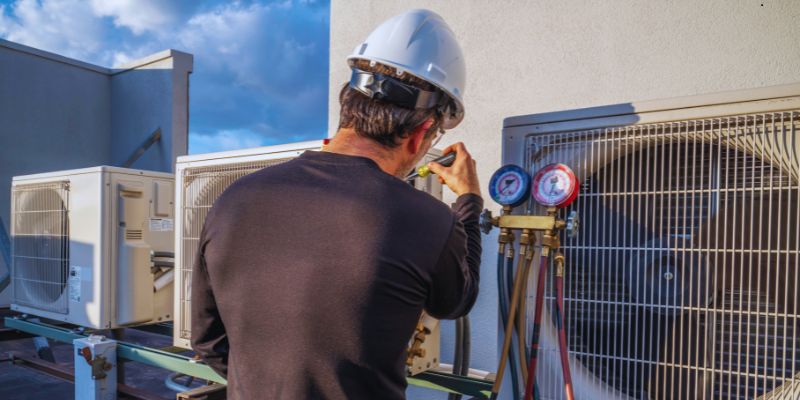
As an expert technician, I can tell you that a system tune-up is more than just a quick check. We use advanced diagnostic tools to measure your system’s static pressure and delivered CFM. If we find an issue, we can identify the cause, whether it’s improper duct sizing, a blocked coil, or the need for duct balancing.
Don’t let poor airflow compromise your comfort. If you’re in the Central Florida area, visit us or give us a call to schedule airflow testing and get your system running at its best.
Frequently Asked Questions (FAQs)
Here are answers to some common questions homeowners have about HVAC airflow.
1. What is CFM again, in simple terms?
CFM, or Cubic Feet per Minute, is the measurement of how much air your HVAC system’s fan moves in one minute. It’s the key metric for determining if your system is delivering the right amount of conditioned air to your living spaces.
2. What’s the difference between CFM and FPM?
CFM measures the volume of air (how much), while FPM (Feet Per Minute) measures the velocity of air (how fast). You can have high velocity (FPM) but low volume (CFM) if the air is moving through a very small opening, like a mostly-closed vent.
3. How much CFM does each room need?
The required CFM for each room depends on its size, window exposure, and heating/cooling load. Technicians perform calculations and use a process called duct balancing, which involves adjusting dampers in the ductwork to ensure each room receives its designated share of airflow.
4. What are the signs of low CFM?
Common signs include rooms that are always too hot or cold, weak airflow coming from vents, your AC or furnace running constantly, and unexpectedly high energy bills. You might also notice your outdoor AC unit icing up in the summer.
5. Does a higher CFM rating always mean better performance?
Not necessarily. The goal is to have the correct CFM, not the highest. A system that is oversized or has too much airflow can be inefficient, noisy, and fail to properly dehumidify your home. Your system should be perfectly matched to your home’s needs and your ductwork’s capacity.