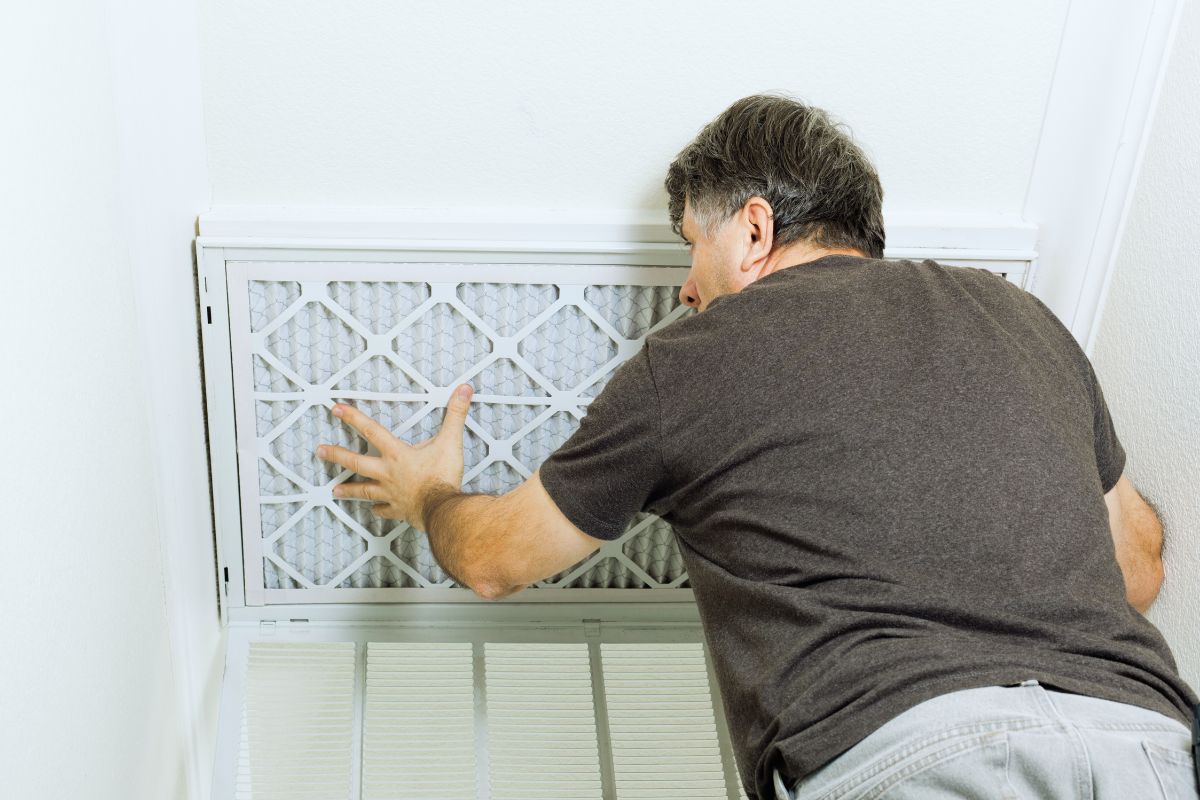
Walking through the air filter aisle at the hardware store can feel surprisingly overwhelming. You see rows of filters in dozens of different sizes, thicknesses, and ratings. It’s easy to grab what looks right, only to get home and find it’s a quarter-inch too wide or an inch too short. Choosing the correct air conditioner filter size is one of the most important (and simple) things you can do for your home’s HVAC system, and we’re here to make it easy.
As HVAC professionals, we’ve seen firsthand how a simple filter mismatch can impact comfort, efficiency, and even the lifespan of an air conditioner. This guide will walk you through everything you need to know, from finding your filter’s measurements to understanding what all those numbers on the packaging really mean. Let’s clear the air and get you the right filter, every time.
Why Does the AC Filter Size Matter?
You might wonder if a filter that’s “close enough” is okay. Unfortunately, even a small gap can cause big problems. An improperly sized filter allows dust, pollen, and other airborne particles to bypass the filter media and enter your HVAC system and your home’s air.
Here’s why getting the size exactly right is crucial:
- Better Airflow: A filter that’s too small or too large can obstruct airflow, forcing your AC system to work harder than it should. Proper airflow is key to efficient cooling and heating.
- Improved Efficiency: When your system works harder, it uses more energy. A correctly sized filter helps your unit run smoothly, keeping your utility bills in check.
- Enhanced Indoor Air Quality: The filter’s job is to trap contaminants. If air is sneaking around the edges, those particles are circulating right back into the air you breathe.
- System Longevity: Unfiltered dust and debris can build up on sensitive internal components like the evaporator coil and blower motor. This accumulation can lead to costly repairs and shorten the lifespan of your entire HVAC system.
How to Find Your Air Conditioner Filter Size: A Step-by-Step Guide
Finding your filter size is a straightforward process. Most of the time, the information is printed right where you need it. Here’s how to find it in just a few minutes.
Step 1: Locate Your Air Filter
First, you need to find where your filter is housed. In most homes, it will be in one of two places:
- In the return air vent: This is the large grate, often on a wall or ceiling, that pulls air into the HVAC system. You can usually open it with latches or by unscrewing a thumbscrew. The filter will be right inside.
- In the air handler: The filter might also be in a slot on the air handler unit itself (the indoor component of your AC system, often in a closet, attic, or garage). Look for a cover or slot labeled “Filter.”
Turn off your thermostat before removing the filter to prevent the system from pulling in unfiltered air while you work.
Step 2: Check the Existing Filter’s Frame
Once you’ve removed the old filter, look at its cardboard frame. The manufacturer almost always prints the filter’s dimensions directly on the side. You will see three numbers, such as “16 x 25 x 1.” This is your filter’s size.
Step 3: Understand Nominal vs. Actual Size
This is where many homeowners get confused. The size printed on the filter (e.g., 20 x 20 x 1) is the nominal size. It’s a rounded number used for easy labeling.
The actual size is the filter’s true measurement, which is usually a fraction of an inch smaller. For example, a filter with a nominal size of 16 x 25 x 1 might have an actual size of 15.5 x 24.5 x 0.75 inches. This slight difference ensures it fits snugly into the filter slot without being too tight. ‘
When buying a new filter, you only need to know the nominal size, the manufacturer has already accounted for the difference.
Step 4: What to Do If the Size Isn’t Printed
If the size isn’t printed on the old filter, or if you suspect it was the wrong size to begin with, you’ll need to measure it yourself. Use a tape measure and record three dimensions:
- Length (L)
- Width (W)
- Thickness/Depth (D)
Measure from edge to edge and round up to the nearest whole inch to find the nominal size. For example, if you measure 19.5 x 24.5 x 0.75 inches, you need a 20 x 25 x 1 filter.
A Quick Reference
While filter sizes can vary greatly, some are more common in residential homes than others. You’ll often find these sizes at your local hardware store:
- 16x20x1
- 16x25x1
- 20x20x1
- 20x25x1
- 20x30x1
- 25x25x1
Remember, this is just a small sample. Your system might require a different or even a custom filter size. Always rely on the measurements of your specific unit, not on what seems standard.
Filter Thickness
The third number in your filter’s dimensions is its thickness, or depth. This is a critical measurement, as a filter that is too thick will not fit in the designated slot.
- 1-Inch Filters: These are the most common type found in residential HVAC systems. They are widely available and affordable. Because they have less surface area, they need to be changed more frequently, typically every 1 to 3 months.
- 2-Inch Filters: These offer a step up from 1-inch filters with more surface area for capturing particles. They can often last a bit longer, but your system must have a slot deep enough to accommodate them.
- 4-Inch to 5-Inch Filters: Often called media filters, these pleated filters offer superior filtration and a much longer lifespan, typically lasting 6 to 12 months. They have significantly more surface area, which allows for better airflow and particle capture. These filters require a special, deeper filter housing and cannot be used in a standard 1-inch slot.
What is a MERV Rating?
When you look at a filter’s packaging, you’ll see a MERV rating, which stands for Minimum Efficiency Reporting Value. In simple terms, MERV tells you how effective the filter is at trapping airborne particles. The scale runs from 1 to 20; the higher the number, the smaller the particles it can capture.
- MERV 6-8: This is the standard for most residential systems. These filters do a great job of capturing basic particles like dust, pollen, and lint. They offer a good balance between filtration and airflow.
- MERV 9-12: This is a better choice for households with pets or people who suffer from mild allergies. These filters trap finer particles like pet dander and mold spores.
- MERV 13+: These high-efficiency filters capture even smaller particles, including some bacteria and virus carriers. They are excellent for homes where air quality is a major concern due to severe allergies, asthma, or compromised immune systems.
Important: Before you upgrade to a high-MERV filter, check your HVAC system’s manual or consult a professional. Some older or smaller systems are not designed to handle the restricted airflow that comes with a denser, high-MERV filter. Forcing it could strain your system’s fan motor.
Your Expert Partner in Central Florida: Fahrenheit AC
Finding the right filter is a great first step toward better air quality and system performance. Here at Fahrenheit AC, we help homeowners across Central Florida keep their homes comfortable and their air clean. If you’re ever unsure about your air conditioner filter size, need help with a custom filter, or want to explore upgrading your system to accommodate higher-efficiency media filters, our team is here to help.
We provide expert maintenance, repair, and installation services to ensure your HVAC system runs at its best. For professional advice and service, you can learn more about us at fahrenheitacfl.com.
Recommended Filter Replacement Schedules
How often should you change your filter? It depends on your filter type and your household.
- Average Home (No Pets, No Allergies): Every 90 days for a 1-inch filter.
- Home with a Pet: Every 60 days.
- Multiple Pets or Allergies: Every 30-45 days.
- Smokers in the Household: Every 30 days.
- Vacation Home (or infrequent use): Every 6-12 months.
- During Heavy Use (e.g., summer) or Construction: Check monthly.
For thicker media filters (4+ inches), follow the manufacturer’s recommendation, which is typically every 6 to 12 months.
Frequently Asked Questions (FAQs)
Can I use a filter that’s a slightly different size?
No, you should always use the exact nominal size required for your system. A filter that is too small allows unfiltered air to pass, while one that is too large won’t fit or will bend, creating gaps.
Is a higher MERV rating always better?
Not necessarily. While a higher MERV rating means better filtration, it also means more restricted airflow. Some systems are not powerful enough to pull air through a dense MERV 13+ filter, which can strain the fan motor and reduce efficiency. It’s best to stick with the manufacturer’s recommended MERV range, which is typically between MERV 6 and 12 for most residential units.
What happens if I forget to change my air filter?
A clogged filter severely restricts airflow, forcing your system to work much harder to cool or heat your home. This leads to higher energy bills, reduced comfort, poor indoor air quality, and can cause the system to overheat or freeze up, leading to expensive repairs.
I can’t find my filter size at the store. What should I do?
If you have an uncommon or older unit, you may need a custom filter size. Many online retailers specialize in creating filters to your exact measurements. An HVAC professional can also help you source the correct filter.
Does the arrow on the filter matter?
Yes, absolutely. The arrow indicates the direction of airflow. It should always point toward the air handler and away from the return air duct. This ensures the filter is positioned correctly to trap debris.